
Regional
Projects
Ḥorvat Tevet and the broader landscape of the Jezreel Valley.
Ḥorvat Tevet: Regional Research
The archaeological excavations at Tel Shaddud are part of a broader regional effort to understand the shifting political and economic landscapes of the Jezreel Valley. Headed by our co-directors Prof. Omer Sergi and Dr. Karen Covello-Paran, the excavations at the nearby site of Ḥorvat Tevet offer a critical comparative perspective.
While Tel Shaddud highlights the presence of an Egyptian “royal estate” and its impact on local communities in the Late Bronze Age, Ḥorvat Tevet provides evidence of a later Israelite administrative hub and subsequent Assyrian imperial influence. Together, these sites reveal the long-term history of the valley as a center for royal administration, agricultural production, and intercultural exchange across three millennia.
In The Media

This article details the sensational discovery of a high-status Neo-Assyrian cremation burial at the margins of Ḥorvat Tevet — one of the richest Iron Age assemblages ever found in the Southern Levant. Project co-director Prof. Omer Sergi explains that the presence of luxury imperial goods, such as a glazed Assyrian bottle and a rare cylinder seal, suggests the tomb belonged to a high-ranking official or even a provincial governor. The piece highlights how this discovery is reshaping our understanding of the Assyrian occupation of the Jezreel Valley, revealing a level of direct imperial administration and local investment that was previously unknown.


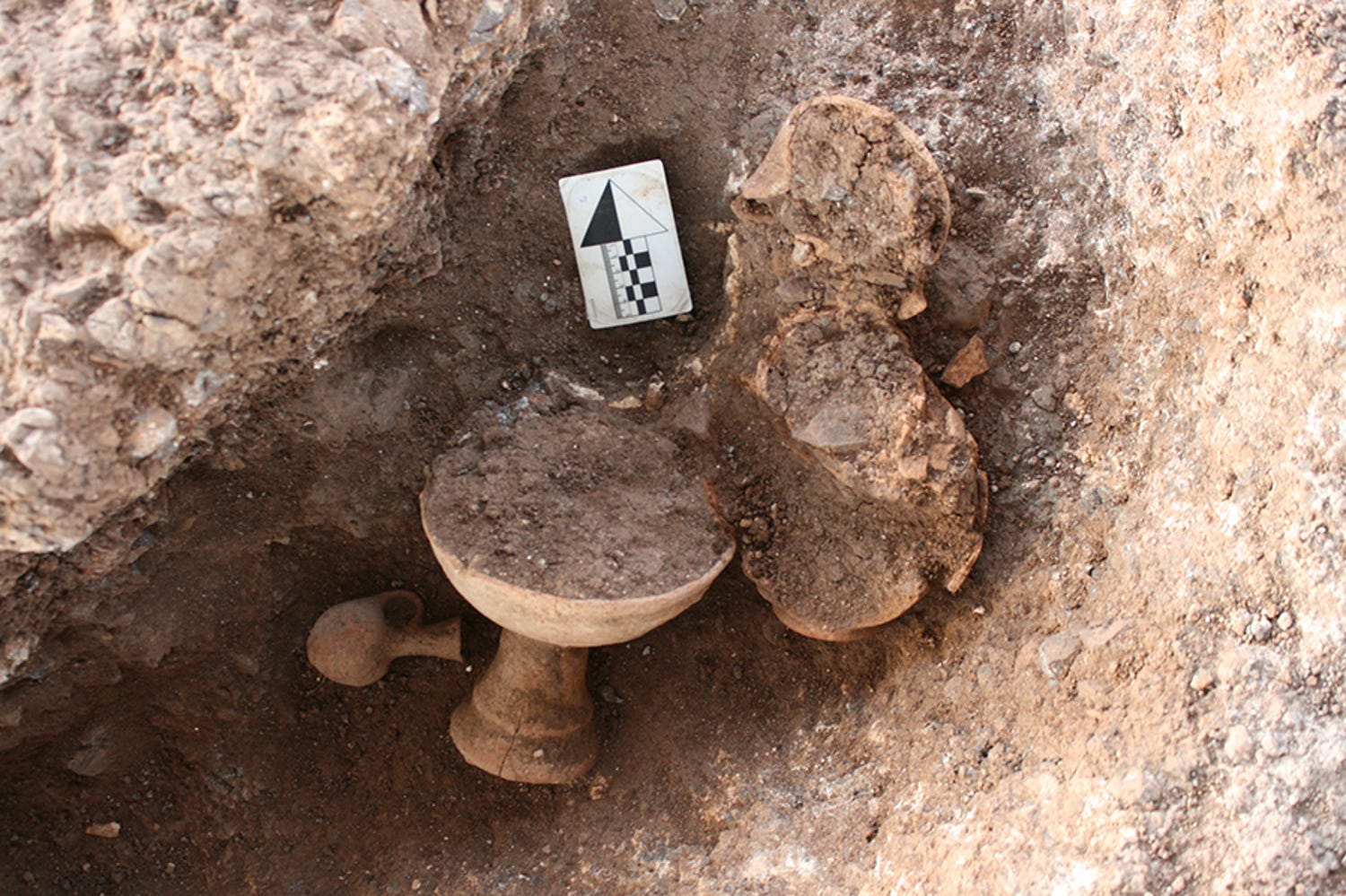
This article explores the discovery of a rural cemetery at Ḥorvat Tevet dating to the 11th and early 10th centuries BCE, a period that marks the transition from the Canaanite city-states to the rise of the Kingdom of Israel. Project co-director Prof. Omer Sergi explains that the inhabitants were likely poor farmers whose burial practices, including the use of beeswax and fire rituals, offer a rare glimpse into the birth pangs of the biblical kingdom.
Published Articles

A Unique Assemblage of Cremation Burial from Ḥorvat Tevet and Assyrian Imperial Rule in the Jezreel Valley.
Omer Peleg, Karen Covello-Paran, Hannes Bezzel, Yuval Gadot and Omer Sergi, 2025.
Published in Tel Aviv: Journal of the Institute of Archaeology of Tel Aviv University, Vol. 52. This article explores a rare 7th-century BCE cremation burial found at Ḥorvat Tevet, which contained high-status Neo-Assyrian luxury goods, including a glazed bottle and an alabastrum. The findings suggest that the site served as a strategic administrative link to the Assyrian provincial capital at Megiddo.

Palace-Clan Relations in the Bronze and Iron Ages Levant: Textual and Material Approaches.
Hannes Bezzel, Karen Covello-Paran, Joachim J. Krause and Omer Sergi, 2025.
Published in Archaeology of the Biblical Worlds, Vol. 6. De Gruyter. This volume, edited by the co-directors of the Tel Shaddud Regional Project, offers a groundbreaking re-evaluation of the social and political fabric of the ancient Levant. Challenging the traditional “tribe-to-state” evolutionary model, the collected studies demonstrate how kinship-based identities (clans) and centralized political organizations (palaces) coexisted and interacted throughout the Bronze and Iron Ages. By integrating archaeological data with textual analysis, the book reveals the fragmented and kin-based nature of Levantine polities, providing a crucial framework for understanding the complex societal structures that shaped sites like Tel Shaddud and Ḥorvat Tevet.

Great pots look alike – social and political aspects of mass production of standardized storage jars in early monarchic Israel (late 10th-9th century BCE)
Ortal Harush, Madeleine Harush, Anastasia Shapiro, Karen Covello-Paran and Omer Sergi, 2025.
Published in Journal of Archaeological Science: Reports, Vol. 66, this article focuses on the Hippo Jar, primarily found in the northern valleys of the Southern Levant. Researchers suggest a link between the widespread production of these jars and the systematic control of the Kingdom of Israel. Researchers highlight the combination of 3D methodologies, advanced shape analysis, and provenance studies, enabling the detection of consistent, repeatable, and stable characteristics in final products.

A Bronze/Iron-Age Scarab in a Middle Islamic Context: The Use of Ancient Objects in Later Periods
Noa Ranzer, Jordan Weitzel, Omer Sergi, Karen Covell-Paran and Ido Koch, 2025.
Published in Israel Exploration Journal, Vol. 74, No. 2, the excavation of a Middle Islamic period cemetery in Ḥorvat Tevet uncovered a skeleton with a scarab bearing the throne name of Thutmose III. This Middle Islamic burial marks the latest attestation of a phenomenon in which Bronze and Iron Age scarabs would be deposited in later period burials. The article presents the burial context, the scarab itself, and the findspot of the scarab near the neck, suggesting it may have been a part of a necklace. The subsequent discussion explores the appropriation and use of ancient objects in the past and raises doubts about whether its last owners possessed the knowledge of its original function or the significance of the Egyptian hieroglyphs.

Ḥorvat Tevet, the Jezreel Valley: A Village and an Israelite Royal
Omer Sergi, Hannes Bezzel, Yoav Tsur, and Karen Covello-Paran, 2024.
Published in Levant: The Journal of the Council for British Research in the Levant, Vol. 56, Issue 1., this article uses evidence from pottery assemblages, faunal remains, and various means of production detected at the site, to argue for Ḥorvat Tevet’s use as an administrative center of a royal estate in early monarchic Israel. The article further discusses the archaeological evidence for royal estates and the origins of royal economy in the Southern Levant during the Late Bronze Age.

Bronze Anklets from Ḥorvat Tevet (Jezreel Valley): New Light on Exchange and Identity Construction in the Iron I
Jordan Weitzel, Omer Sergi, Karen Covello-Paran, Hannes Bezzel, Omri Yagel, Yehudit Harlavan and Erez Ben-Yosef, 2024.
Published in Palestine Exploration Quarterly, Vol. 157, Issue 2, This article presents the results of lead isotope analysis (LI) conducted on four bronze anklets from an early Iron Age burial. The results show that the copper in these items most likely originated in Timna, demonstrating that Arabah copper dominated the region in the early Iron Age. It also concludes that the burial was likely the burial of a high-status female.

Strategies of Animal Exploitation in Late Iron Age IIA Ḥorvat Tevet (the Jezreel Valley) Reveal Patterns of Royal Economy in Early Monarchic Israel
Abra Spiciarich, Omer Sergi, Karen Covello-Paran, Yoav Tsur, Hannes Bezzel and Lidar Sapir-Hen, 2023.
Published in Palestine Exploration Quarterly, Vol. 156, Issue 3, this article uses faunal remains from Ḥorvat Ṭevet to reveal patterns of a complex redistributive apparatus during the Late Iron IIA and assesses a large assemblage of animal bones within inter- and intra-site comparative analyses. Inter-site comparisons to contemporary sites in the northern valleys of Israel demonstrate that the agricultural production of grain and animal by-products went far beyond the site’s local needs. Meanwhile, an intra-site comparison reveals a hierarchical distinction in the consumption patterns between elites and the labor force.

The Early Iron Age Cemetery of Ḥorvat Ṭevet: Life and Death in a Rural Community in the Jezreel Valley
Jordan Weitzel, Karen Covello-Paran, Hannes Bezzel, Oded Lipschits and Omer Sergi, 2024.
Published in The American Journal of Archaeology, Vol. 128. Recent salvage excavations at Ḥorvat Ṭevet revealed a cemetery consisting of at least 25 b urials dated to the Iron I period (11th-10th centuries BCE). This article analyzes burial practices of the cemetery to shed light on the social complexity, economy, and funerary rituals. Based on the finds in the graves and variations between graves, it is concluded that the site was home to a community characterized by minimal wealth accumulation, limited social division, and few long-distance trade contacts.
The Late Iron IIA Cylindrical Holemouth Jars and Their Role in the Royal Economy of Early Monarchic Israel
Madeleine Butcher, Karen Covello-Paran, Paula Waiman-Barak, Oded Lipschits, Hannes Bezzel and Omer Sergi, 2022.
Published in Tel Aviv: Journal of the Institute of Archaeology of Tel Aviv University, Vol. 49, this article offers a comprehensive analysis of cylindrical holemouth jars and includes a study of typology and morphology,
alongside the analysis of provenance and distribution patterns. By shedding new light on these vessels, this paper provides the opportunity to understand and illustrate the economy of early monarchic Israel.

Ḥorvat Ṭevet in the Jezreel Valley: A Royal Israelite Estate
Omer Sergi, Hannes Bezzel, Yoav Tsur and Karen Covello-Paran, 2021.
Published by the Israel Antiquities Authority, this paper argues that Ḥorvat Ṭevet, a small (ca. 5 ha.) site in the Jezreel Valley, was a royal agricultural estate, namely collection and redistribution center for agricultural output in the service of the royal Israelite elite. Moreover, as Ḥorvat Ṭevet is contemporaneous with the formation of the Kingdom of Israel, understanding its operations is expected to shed light on the relational dynamics between the Israelite ruling elites and the rural communities in the Jezreel Valley.

Heated beeswax usage in mortuary practices: The case of Ḥorvat Tevet
(Jezreel Valley, Israel) ca. 1000 BCE
Ayala Amir, Yuval Gadot, Jordan Weitzel, Israel Finkelstein, Ronny Neumann, Hannez Bezzel, Karen Covell-Paran and Omer Sergi, 2021.
Published in Journal of Archaeological Science: Reports, Vol. 36., the articles presents and discusses the results of Residue Analysis performed on 27 pottery vessels, placed as offerings in burials dating to the Iron I period (ca. 1050–900 BCE). The results show that heated beeswax was used during the burial ceremonies and placed in variety of vessels. These results shed new light on burial practices of South Levantine rural communities.