
Academic Literature Published in Recent Years
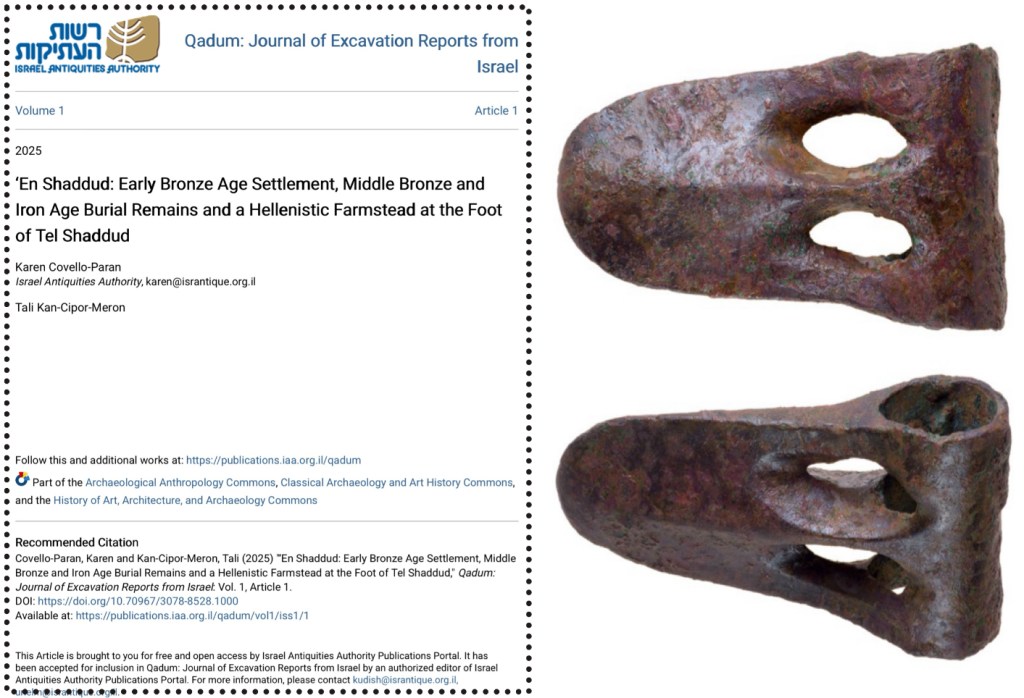
By Karen Covello-Paran and Tali Kan-Cipor-Meron, 2025.
Published in Qadum: Journal of Excavation Reports from Israel, Vol. 1.
This article presents the results of excavations conducted at the foot of Tel Shaddud, revealing a sequence of occupation layers spanning from the Early Bronze Age to the Hellenistic period. The study identifies an Early Bronze I settlement, Middle Bronze “warrior” burials containing arsenic-copper weapons, an Iron Age I grave, and a well-built Hellenistic farmstead. Together, these discoveries illuminate the long-term development of settlement and mortuary activity around the spring of ‘En Shaddud and provide crucial evidence for the shifting landscape use of the Jezreel Valley over three millennia.
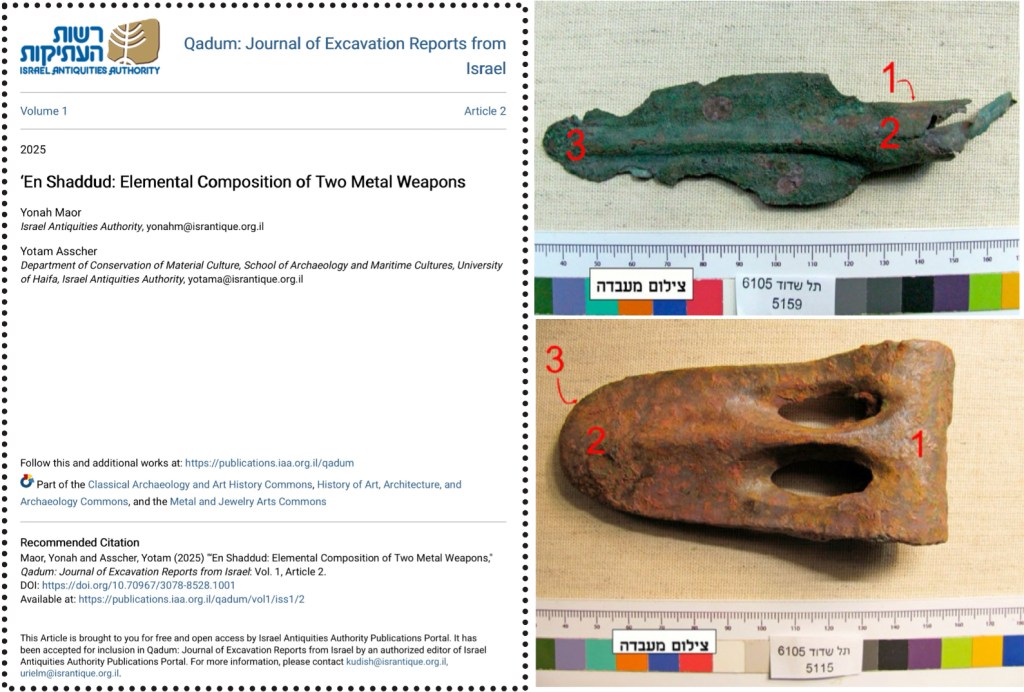
‘En Shaddud: Elemental Composition of Two Metal Weapons.
By Yonah Maor and Yotam Asscher, 2025.
Published in Qadum: Journal of Excavation Reports from Israel, Vol. 1.
This study presents the compositional analysis of two Middle Bronze Age I metal weapons discovered in burials at Tel Shaddud – a socketed spearhead and a “duckbill” axe. Using X-ray fluorescence (XRF) analysis, the researchers identified both artifacts as made of arsenic-copper alloy, with notable variations in trace elements, including elevated lead levels in the axe. These findings provide new insights into Bronze Age metallurgy, demonstrating the technological skill and adaptive resource management of metalworkers in the northern Levant and enriching our understanding of Shaddud’s role within regional trade and production networks.
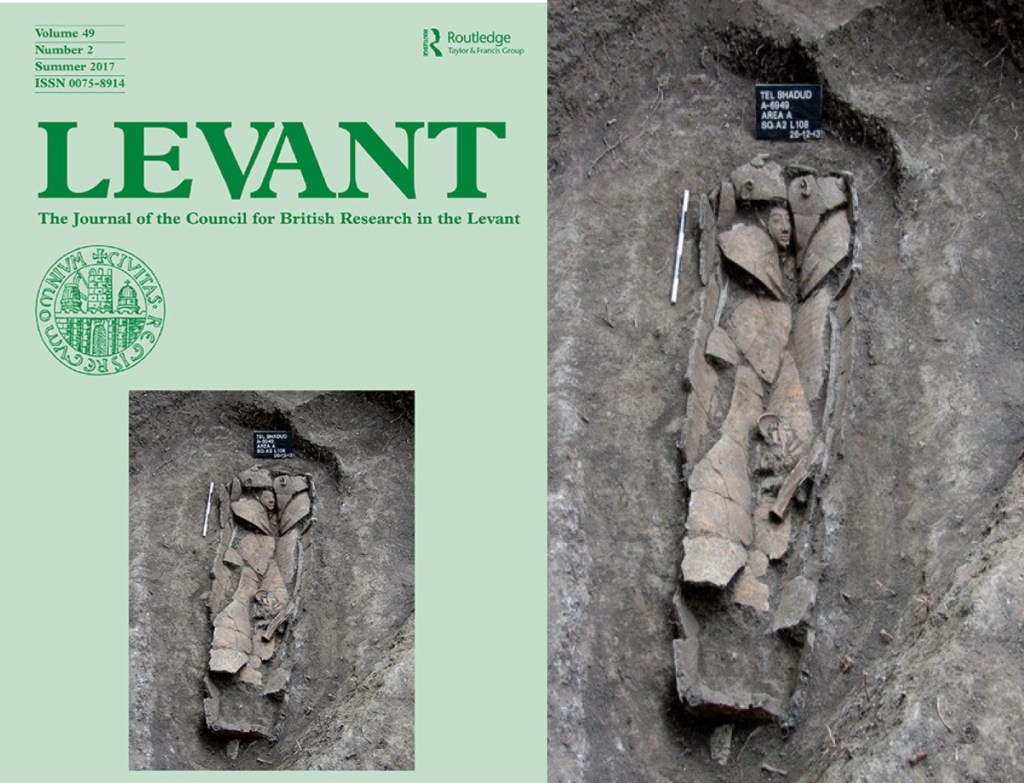
By Edwin C.M. van den Brink, Ron Be’eri, Dan Kirzner, Enno Bron, Anat Cohen-Weinberger, Elisheva Kamaisky, Tamar Gonen, Lilly Gershuny, Yossi Nagar, Daphna Ben-Tor, Naama Sukenik, Orit Shamir, Edward F. Maher and David Reich, 2017. Published in Levant, Vol. 49, No. 2.
This article reports on the significant discovery of a 13th-century BCE anthropoid clay coffin during trial excavations at the eastern foot of Tel Shaddud. The burial, which contained the remains of a single individual accompanied by Egyptian and Egyptian-style funerary gifts, including a scarab of Pharaoh Seti I, points to a direct connection with the Egyptian New Kingdom administration. Tel Shaddud likely served as an Egyptian way station or royal estate, playing a strategic role in the colonization and management of the Jezreel Valley during the Late Bronze Age II.
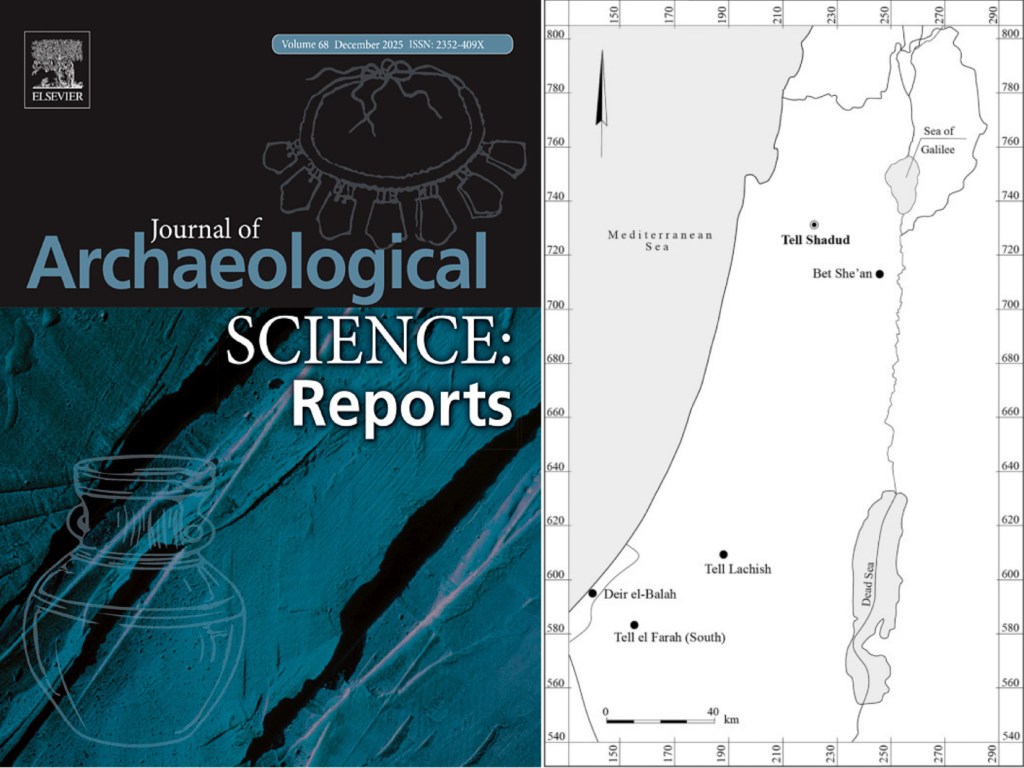
Dvory Namdar, Shlomo Shoval, Alon Amrani, Edwin C.M. van den Brink, Dan Kirzner and Ron Be’eri, 2017.
Published in Journal of Archaeological Science: Reports, Vol. 12.
This article presents the scientific analysis of the anthropoid clay coffin found at the foot of Tel Shaddud, focusing on the identification of organic compounds absorbed into the ceramic fabric. The researchers identified the presence of highly degraded beeswax, which was likely applied to the coffin as a sealant or coating during the funerary process. The discovery of beeswax, a material often associated with Egyptian mummification and ritual practices, provides evidence for the specific burial treatments used at the site. These findings reinforce the interpretation of Tel Shaddud as a high-status Egyptian-style outpost and offer new insights into the transfer of sophisticated mortuary technologies from New Kingdom Egypt to the Jezreel Valley.
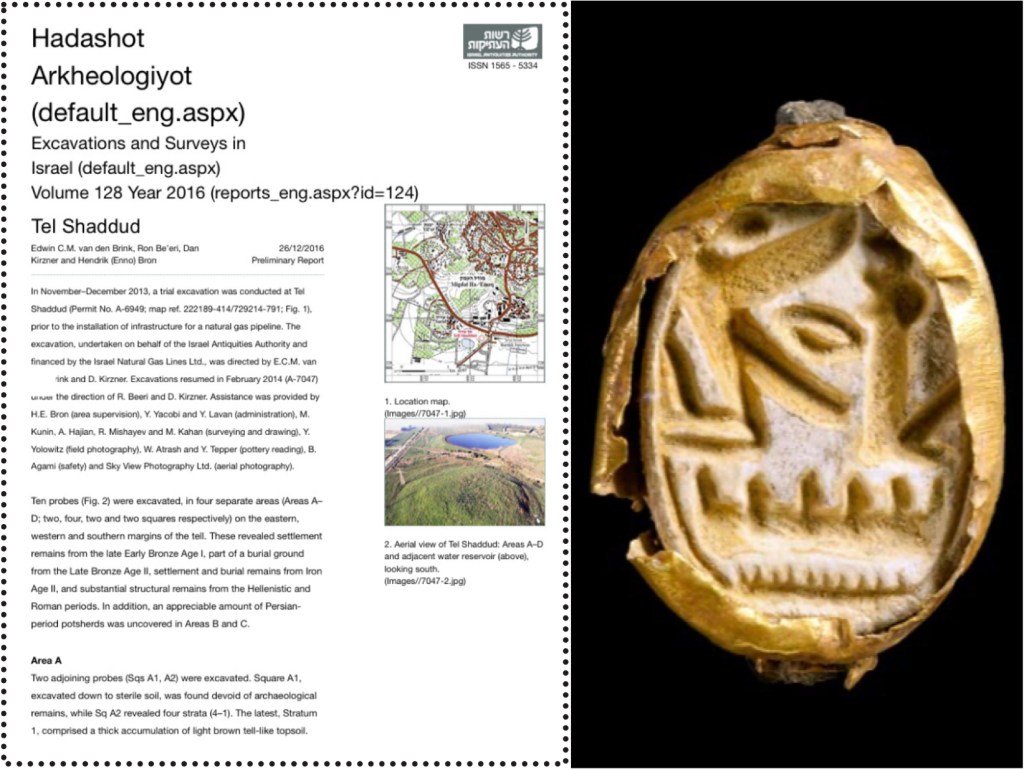
Tel Shaddud: Preliminary Report.
Edwin C.M. van den Brink, Ron Be’eri, Dan Kirzner and Hendrik (Enno) Bron, 2016.
Published in Hadashot Arkheologiyot: Excavations and Surveys in Israel, Vol. 128.
This article presents the preliminary findings from a 2013-2014 salvage excavation across four areas (A-D) on the margins of Tel Shaddud. A major highlight is the discovery of a Late Bronze Age II burial ground in Area A, featuring an anthropoid clay coffin with a scarab of Pharaoh Seti I, which suggests the presence of an Egyptian-style military garrison. The report also documents Iron Age II burials and mud-brick structures, Hellenistic building remains, and a Middle Roman agricultural complex containing stone vessels associated with Jewish purity laws.
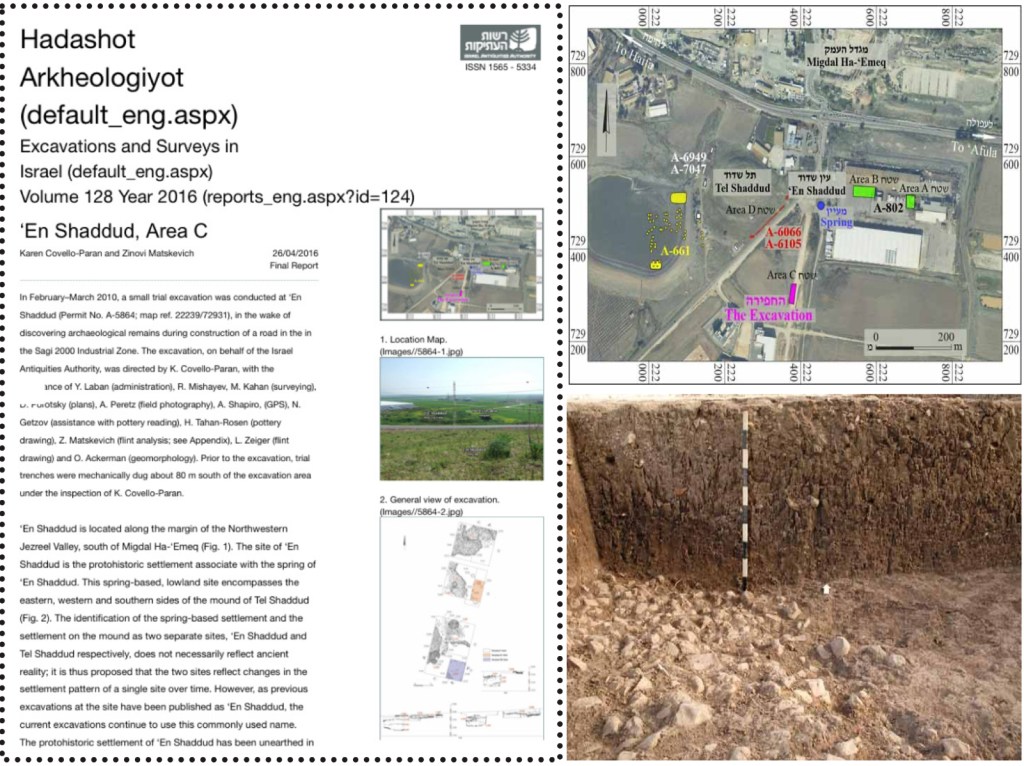
‘En Shaddud, Area C: Final Report.
Karen Covello-Paran and Zinovi Matskevich, 2016.
Published in Hadashot Arkheologiyot: Excavations and Surveys in Israel, Vol. 128.
This report details the results of a 2010 trial excavation in Area C at ‘En Shaddud, uncovering three occupational strata dating to the Early Bronze Age IA and IB. The findings include a series of stone floors and a significant pottery assemblage featuring gray-burnished ware and various holemouth jar types. The excavation reveals evidence of periodic flooding that influenced the settlement’s size over time and provides crucial data for reconstructing the layout of the sprawling EB I village at the margins of the Jezreel Valley.
 Tel Shaddud